
Economía social: un impulso hacia la sostenibilidad para un bien común
Barra lateral del artículo
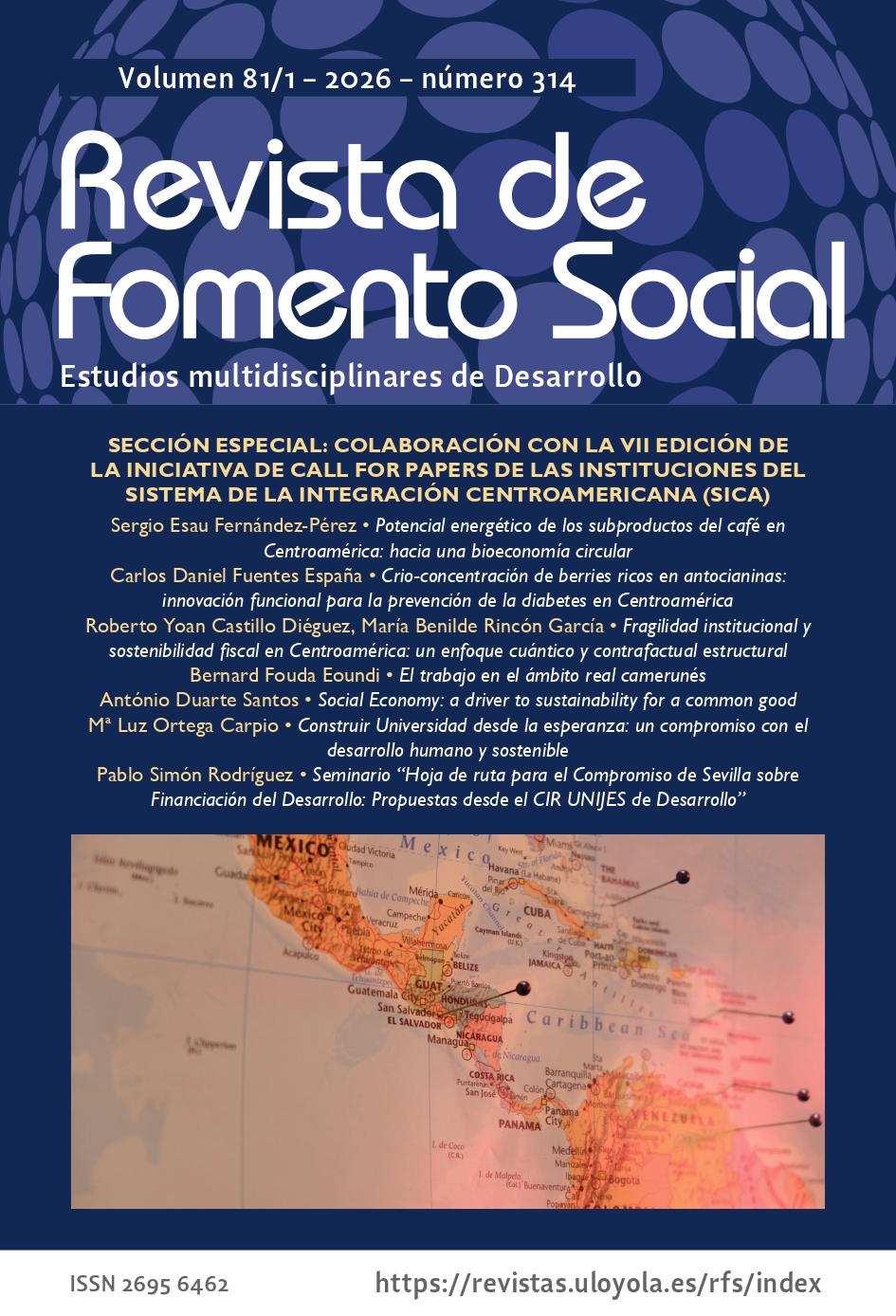
Contenido principal del artículo
Resumen
La Economía Social trasciende el paradigma económico al conciliar la eficiencia con la responsabilidad social. Prioriza la preservación del ciclo de vida de las sociedades, lo que implica equilibrar los intereses de todas las partes implicadas, como se refleja en la aprobación en 2023 de una resolución de las Naciones Unidas que fomenta la Economía Social y Solidaria para el Desarrollo Sostenible. Evaluamos las variables que Portugal ha recopilado para alcanzar este objetivo. A través del tratamiento de datos relevantes de la Cuenta Satélite de la Economía Social, analizamos su sostenibilidad como bien común. Buscamos comprender cómo es posible promover la calidad de vida colectiva a través de este sector. Su contribución al bienestar individual es de gran relevancia. Como inferencia, la Economía Social en Portugal representa una contribución decisiva a la realidad social, redefiniendo el éxito de la equidad. Su impacto es positivo, si bien requiere instrumentos políticos para potenciar su creciente desarrollo en el futuro.
Descargas
Detalles del artículo

Esta obra está bajo una licencia internacional Creative Commons Atribución-NoComercial-SinDerivadas 4.0.
Los autores afirman reconocer que la Revista de Fomento Social asume como suyos los derechos de propiedad intelectual sobre sus trabajos y otorgan a la revista los permisos de distribución y comunicación pública de los mismos establecidos en las declaraciones de Berlin, Bethesda y Budapest; razón por la cual aceptan que el trabajo que se presenta sea distribuido en acceso abierto, resguardando los derechos de autor bajo una licencia “Creative Commons Reconocimiento-NoComercial-SinObraDerivada 4.0 (CC BY-NC-ND).

Se puede copiar, usar, difundir, transmitir y exponer públicamente siempre que:
Citen la autoría del trabajo, la publicación en Revista de Fomento Social, número, año y las páginas en la que encontraron la información.
No se puede obtener ningún beneficio comercial.
Se anima a los autores a difundir el artículo vía electrónica (Revista de Fomento Social, número, año, paginación, ISSN, DOI, etc.), para favorecer su circulación y difusión, aumentar en su citación y alcance entre la comunidad académica.
La información de la revista se facilitará a Dulcinea
Citas
ABALROADO, T. (2024). Resources and dynamic capabilities as pillars of sustainability in the social economy. CES -Cooperativismo e Economia Social, Núm. 46 (2023-2024), pp. 21-42. DOI: https://doi.org/10.35869/ces.v0i46.5554
AGUDELO, M. A. L., JÓHANNSDÓTTIR, L., & DAVÍDSDÓTTIR, B. (2019). A literature review of the history and evolution of corporate social responsibility. International Journal of Corporate Social Responsibility, 4(1), pp. 1-23. DOI: https://doi.org/10.1186/s40991-018-0039-y
ASHRAF, A., BILLAH, M., AYOOB, M., ZULFIQAR, N. (2024). Analyzing the Impact of Microfinance Initiatives on Poverty Alleviation and Economic Development. Review of Applied Management and Social Sciences (RAMSS), Vol. 7, (4), pp. 431-448. DOI: https://doi.org/10.47067/ramss.v7i4.392
Bassi, A., Fabbri, A. (2020). Under pressure: Evolution of the social economy institutional recognition in the EU. Annals of Public and Cooperative Economics: Volume 91, Issue 3, pp. 411-433. DOI: https://doi.org/10.1111/apce.12264
BASSI, A. (2025). The Terminological Debate. In: BASSI, A., AQUINO ALVES, M., CORDERY, C. (eds). The Future of Third Sector Research. Nonprofit and Civil Society Studies. Springer, Cham. https://doi.org/10.1007/978-3-031-67896-7_5. DOI: https://doi.org/10.1007/978-3-031-67896-7_5
BERRY, L., DANAHER, T., KEININGHAM, T., AKSOY, L., ANDREASSEN, T. (2024). Social Profit Orientation: Lessons from Organizations Committed to Building a Better World. Journal of Marketing, 89(2), 1-19. https://doi.org/10.1177/00222429241258495. ~ DOI: https://doi.org/10.1177/00222429241258495
BHUVANESWARI, S., & SHAILAJA, N. (2024). The Role of Social Entrepreneurs in Addressing Urban Poverty: A Global Perspective. Library Progress International, Vol. 44, No.3, Jul-Dec: P.20231-20242.
BRAUN, S., TAPIA, P., & MAUER, R. (2024). Exploring policy entrepreneurs’ modes of action: Positioning, networking, outmaneuvering, and worldmaking. Applied Psychology, 73(4), 1535–1563. https://doi.org/10.1111/apps.12529. DOI: https://doi.org/10.1111/apps.12529
Cabral S., Mahoney J., McGahan A., Potoski, M. (2019). Value creation and value appropriation in public and nonprofit organizations. Strategic Management Journal, 40: 465–475. https://doi.org/10.1002/smj.3008. DOI: https://doi.org/10.1002/smj.3008
CASES - COOPERATIVA ANTÓNIO SÉRGIO PARA A ECONOMIA SOCIAL (2023). Nova Conta Satélite da Economia Social 2019-2020. https://cases.pt/conta-satelite-da-economia-social-2019-2020-2/ (consulted on 4 June 2025).
CHEN, Z. (2022). Promotion of the Effectiveness of Corporate Financial Management to Social Benefits. International Journal of Economics and Business Administration, Volume X, Issue 2, pp. 3-18. DOI: https://doi.org/10.35808/ijeba/763
DE ANGELIS, R., & VESCI, M (2025). Circular Economy Business Models, Value Creation and Humane Entrepreneurship: A Micro-Sized and Social Enterprise Perspective. Circular Economy and Sustainability. 5(1):147-160. DOI: https://doi.org/10.1007/s43615-024-00419-w
EUROPEAN COMMISSION (2025). About social economy. The EU Social Economy Gateway. https://social-economy-gateway.ec.europa.eu/about-social-economy_en (consulted on May 28).
— (2024). Benchmarking the socio-economic performance of the EU Social Economy: Improving the socio-economic knowledge of the proximity and social economy ecosystem. European Innovation Council and SMEs Executive Agency (EISMEA). Publications Office of the European Union. Brussels.
— (n/d). Portugal: Social economy at a glance. https://social-economy-gateway. ec.europa.eu/my-country/portugal_en (consulted on 4 June 2025).
EUROPEAN PARLIAMENT (2009). European Parliament resolution of 19 February 2009 on Social Economy (2008/2250(INI)). https://www.europarl.europa.eu/doceo/document/TA-6-2009-0062_EN.html.
EUROPEAN UNION (2012). The Social Economy in the European Union. Report drawn up for the European Economic and Social Committee by the International Centre of Research and Information on the Public, Social and Cooperative Economy (CIRIEC). Brussels.
FLEISCHER, H. & PENDL, M. (2024). The Law of Social Enterprises: Surveying a New Field of Research. European Business Organization Law Review, Jun, Vol. 25, Issue 2, pp. 269-297. DOI: https://doi.org/10.1007/s40804-024-00314-9
GIDRON, B. & DOMARADZKA, A. (2021). The New Social and Impact Economy: An International Perspective. 1st Edition, Kindle Edition. Springer. DOI: https://doi.org/10.1007/978-3-030-68295-8_1
GÜNTHER, S. (2021). Roman Law and Economics. Revue des Études Anciennes 123(2):729-732. Volume I: Institutions and Organizations. –G. DARI-MATTIACCI, D. P. KEHOE eds. –Oxford: University Press, 2020. Roman Law and Economics. Volume II: Exchange, Ownership, and Disputes. –G. DARI-MATTIACCI, D. P. KEHOE eds. -Oxford: University Press, 2020.
HERWEG, N., ZAHARIADIS, N., & ZOHLNHÖFER, R. (2023). The multiple streams framework. In C. M. WEIBLE (Ed.), Theories of the policy process, 5th ed., pp. 29–64. Routledge. https://doi.org/10.4324/9781003308201-3. DOI: https://doi.org/10.4324/9781003308201-3
IMPACT EUROPE (2025). Portugal Inovação Social (EMPIS). https://www. impacteurope.net/members/portugal-inovacao-social-empis#:~:text=Portugal%20inova%C3%A7%C3%A3o%20Social%20is%20a%20Portuguese%20public%20initiative,Fund%20within%20the%20Partnership%20Agreement%20Portugal%20 2020%20%282014-2020%29.
KARAKAS, C. (2019). Cooperatives: Characteristics, activities, status, challenges. EPRS - European Parliamentary Research Service, PE 635.541, Briefing. https://www.europarl. europa.eu/RegData/etudes/BRIE/2019/635541/EPRS_BRI(2019)635541_EN.pdf.
KUMAR, L., JAIN, P., & SHARMA, A. (2020). A fuzzy goal programme–based sustainable Greenfield supply network design for tyre retreading industry. International Journal of Advanced Manufacturing Technology, Vol. 108 Issue 9/10, pp. 2855-2880. DOI: https://doi.org/10.1007/s00170-020-05140-0
MAZZUCATO, M. (2024). Governing the economics of the common good: from correcting market failures to shaping collective goals. Journal of Economic Policy Reform, Vol. 27, Nº. 1, 1–24. https://doi.org/10.1080/17487870.2023.2280969. DOI: https://doi.org/10.1080/17487870.2023.2280969
MIRKO, P. (2025). Law and Individualism: Balancing Rights, Responsibilities, and Group Dynamics. Central European Public Administration Review, May, Vol. 23, Issue 1, pp. 37-62. DOI: https://doi.org/10.17573/cepar.2025.1.02
MONTGOMERY, T., STEINER, A., BAGLIONI, S. (2022). Crisis, Continuity, and Missed Opportunity: Tracing a Transnational Solidarity Economy across Europe in Turbulent Times. Journal of Social Entrepreneurship, 16(1), 1–21. https://doi.org/10.1080/19 420676.2022.2090415. DOI: https://doi.org/10.1080/19420676.2022.2090415
NEAMTU, G. (2013). The Leftist Obsession: Social Economy and the Illusion of Corporatist Social Responsibility. Annals of Philosophy, Social & Human Disciplines. 2013, Vol. 1, pp. 11-26.
OECD (2023). What is the social and solidarity economy? A review of concepts. OECD Local Economic and Employment Development (LEED) Papers, No. 2023/13, OECD Publishing, Paris, https://doi.org/10.1787/dbc7878d-en. Republic Diary n. º 86/1976, Série I de 1976-04-10. Available in https://dre.pt/web/guest/legislacao-consolidada/-/lc/337/202105311046/73938609/diploma/indice.
PEDROSO, E. (2024). Uma Década de Contas Satélite da Economia Social em Portugal. Economia Social – Leituras e Debates, 21, pp. 82-106. https://www.cases.pt/contasatelitedaes/.
PETRIDOU, E., & MINTROM, M. (2021). A research agenda for the study of policy entrepreneurs. Policy Studies Journal, 49(4), pp. 943-967. DOI: https://doi.org/10.1111/psj.12405
PORTUGAL 2020 (2022). What is Portugal 2020? https://portugal2020.pt/portugal-2020/o-que-e-o-portugal-2020/ (consulted on June 2, 2025).
PORTUGAL INOVAÇÃO SOCIAL 2019 (2022). Discover Innovative Social Projects spread across Portugal. https://portugal2020.pt/conheca-projetos-sociais-inovadores-espalhados-por-portugal/#:~:text=A%20iniciativa%20Portugal%20 I nova%C3%A7%C3%A3o%20S oc ial%20 l an%C3%A7ou%20 uma% -20plataforma,milh%C3%B5es%20de%20euros%20de%20fundos%20da%20 Uni%C3%A3o%20Europeia.
R DEVELOPMENT CORE TEAM (2008). R: A language and environment for statistical computing. R Foundation for Statistical Computing, The Newsletter of the R Project, Volume 8/1, May, Vienna, Austria. ISBN 3 900051 07 0. http://www.Rproject.org.
RAMOS, C. (2019). Conta Satélite da Economia Social 2019-2020 (CSES), Economia Social – Leituras e Debates, nº 6. https://www.revista-es.info/numero_6.html.
RIBAS, W., PEDROSO, B., VARGAS, L., PICININ, C., JÚNIOR, M. (2022). Cooperative Organization and Its Characteristics in Economic and Social Development (1995 to 2020). Sustainability, 14, 8470. https://doi.org/10.3390/su14148470. DOI: https://doi.org/10.3390/su14148470
SMITH, A. (1776/2024). An Inquiry into the Nature and Causes of the Wealth of Nations. Volume I. Publisher: W. Strahan and T. Cadell, London. DOI: https://doi.org/10.1093/oseo/instance.00043218
TABORDA, C., SMIDT, L., SEIBERT, R. (2025). Conscious Capitalism: a new era for business? Environmental & Social Management Journal / Revista de Gestão Social e Ambiental, Vol. 19 Issue 3, p1-16. DOI: https://doi.org/10.24857/rgsa.v19n3-044
TONIOLO, S, PIERETTO, C., & CAMANA, D. (2023). Improving sustainability in communities: Linking the local scale to the concept of sustainable development. Environmental Impact Assessment Review, Volume 101, July, 107126. https://doi.org/10.1016/j. eiar.2023.107126. DOI: https://doi.org/10.1016/j.eiar.2023.107126
VENEZIA, T. (2024). Harmonizing impact: introduction to European social economy satellite accounts. Thesis presented at Nova School of Business and Economics, Portugal. http://hdl.handle.net/10362/181398.
ZERVOUDI, E., MOSCHOS, E., & CHRISTOPOULOS, A. (2025). From the Corporate Social Responsibility (CSR) and the Environmental, Social and Governance (ESG) Criteria to the Greenwashing Phenomenon: A Comprehensive Literature Review About the Causes, Consequences and Solutions of the Phenomenon with Specific Case Studies. Sustainability, 17, 2222. https://doi.org/10.3390/su17052222. DOI: https://doi.org/10.3390/su17052222
ZOPOUNIDIS, C., & LEMONAKIS, C. (2024). The company of the future: Integrating sustainability, growth, and profitability in contemporary business models. Development and Sustainability in Economics and Finance, Volume 1, June, 100003. https://doi. org/10.1016/j.dsef.2024.100003. DOI: https://doi.org/10.1016/j.dsef.2024.100003