
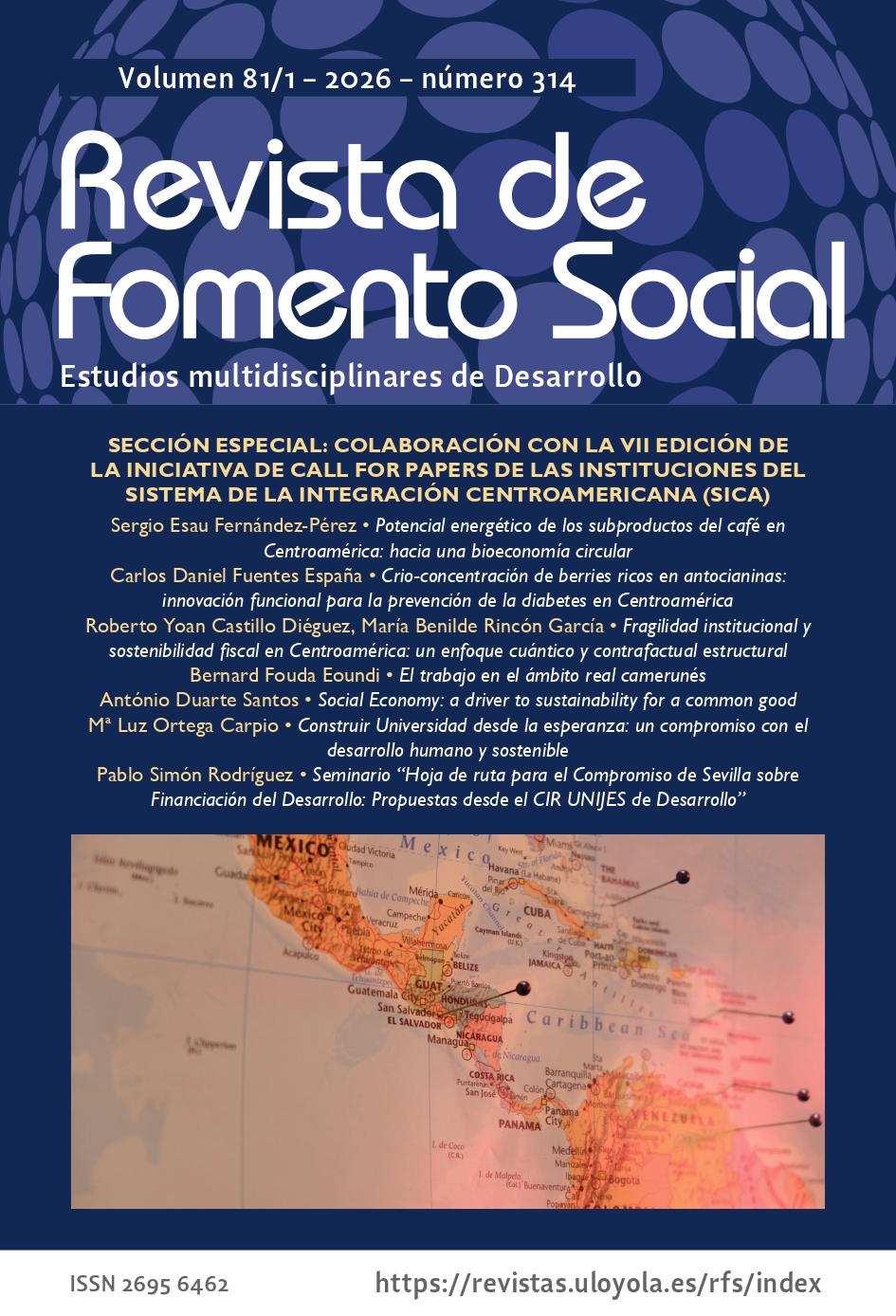
Building a university based on hope: a commitment to human and sustainable development.
Article Sidebar
Main Article Content
Abstract
This article presents the inaugural lecture delivered at the opening of the 2025-26 academic year at Universidad Loyola Andalucía. Focusing on the most urgent challenges facing contemporary society, such as persistent poverty, climate change, inequality, gender inequity, migration, external debt, the decline of international cooperation, and the crisis of multilateralism, it explores the crucial role universities play in promoting human and sustainable development. The need for universities, particularly those with a Jesuit tradition, to foster a citizenship committed to justice, solidarity, and ecological responsibility is emphasized. Building on the concept of "Education for Global Citizenship," the lecture argues that universities must equip students with critical thinking and collaborative decision-making skills to address these global challenges. Furthermore, the integration of Ignatian spirituality—values such as justice, humanity, and faith—into the university’s mission is highlighted, aiming to prepare students for responsible leadership. The lecture concludes with a call to action, urging universities to move from intention to concrete action and to form not just the best in the world, but the best for the world.
Downloads
Article Details

This work is licensed under a Creative Commons Attribution-NonCommercial-NoDerivatives 4.0 International License.
The authors acknowledge that the Revista de Fomento Social assumes as its own the intellectual property rights over their work and grant the journal the permissions of distribution and public communication of the same established in the Berlin, Bethesda and Budapest declarations; for this reason they accept that the work presented be distributed in open access, protecting the copyright under a "Creative Commons Attribution-NonCommercial-NoDerivativeWorks 4.0 (CC BY-NC-ND) license.

You may copy, use, disseminate, transmit and publicly display provided that:
Cite the authorship of the work, the publication in Revista de Fomento Social, issue, year and the pages where you found the information.
No commercial benefit may be obtained.
No derivative works may be made for commercial purposes that are not authorized by the journal.
Authors are encouraged to disseminate the article electronically (Revista de Fomento Social, number, year, pagination, ISSN, DOI, etc.), in order to favor its circulation and diffusion, increase its citation and reach among the academic community.
The information of the journal will be provided to Dulcinea
References
Albanese, F. (2024). Genocidio como borrado colonial: Informe de la Relatora Especial sobre la situación de los derechos humanos en los territorios palestinos ocupados desde 1967 (A/79/384). Asamblea General de las Naciones Unidas. https://docs.un.org/es/A/79/384
Agúndez Agúndez, M. (2008). El paradigma universitario Ledesma–Kolvenbach. Revista De Fomento Social, (252), 603-631. https://doi.org/10.32418/rfs.2008.252.2044
Alkire, S. (2021). The Multidimensional Poverty Index (MPI) 2021: Brief Methodological Note. Oxford Poverty & Human Development Initiative (OPHI).
Alkire, S., & Foster, J. (2011). Counting and multidimensional poverty measurement. Journal of Public Economics, 95(7-8), 476-487.
Alkire, S., & Robles, G. (2021). Unpacking Deprivation Bundles to Reduce Multidimensional Poverty. Oxford Poverty & Human Development Initiative (OPHI).
Alkire, S., & Seth, S. (2015). Multidimensional poverty measurement and analysis: A multidimensional poverty index for low income countries. Oxford University Press.
Alkire, S., & Zavaleta, D. (2020). Global Multidimensional Poverty Index: 2020 Update. Oxford Poverty & Human Development Initiative (OPHI).
Asamblea General de las Naciones Unidas. (2024). Resolución A/RES/ES-10/24: Fin de la ocupación israelí en los territorios palestinos ocupados, incluida Jerusalén Oriental. Naciones Unidas. https://docs.un.org/es/A/RES/ES-10/24
Cortina, A. (2009). Ciudadanos del mundo: Hacia una teoría de la ciudadanía (3.ª ed.). Alianza Editorial.
Cortina, A. (1995, diciembre 1). Aporofobia: El rechazo al pobre. ABC Cultural. Recuperado de https://www.abc.es
Cortina, A. (2017). Aporofobia, el rechazo al pobre: Un desafío para la democracia. Editorial Plataforma.
Francisco. (2015). Laudato si’: Sobre el cuidado de la casa común [Encíclica]. Vaticano: Libreria Editrice Vaticana.
Fundación ETEA, E. de la. (2024). La Fundación ETEA: un modelo de institucionalización y transversalización del Desarrollo y la Cooperación en la Universidad. Revista De Fomento Social, (308), 45-80. https://doi.org/10.32418/rfs.2024.308.5691
Haas, P. M. (2020). The Crisis of Multilateralism: The United States and Global Governance. Global Policy Journal.
Ikenberry, G. J. (2018). A World Safe for Democracy: Liberal Internationalism and the Crises of Global Order. Yale University Press.
International Affairs. (2024). Forgotten conflicts: The urgent need to rediscover the humanity in each other. Recuperado de https://www.internationalaffairs.org.au/australianoutlook/forgotten-conflicts-the-urgent-need-to-rediscover-the-humanity-in-each-other
IPCC, 2023: Summary for Policymakers. In: Climate Change 2023: Synthesis Report. Contribution of Working Groups I, II and III to the Sixth Assessment Report of the Intergovernmental Panel on Climate Change [Core Writing Team, H. Lee and J. Romero (eds.)]. IPCC, Geneva, Switzerland, pp. 7.
Keohane, R. O. (2021). Power and Interdependence. Longman.
Linard, A. (1994). Rehabilitar el desarrollo. Pero ¿qué desarrollo? Revista De Fomento Social, (195), 351-371. https://doi.org/10.32418/rfs.1994.195.2729
Murga-Menoyo, M. Á. (2014). Competencias para el desarrollo sostenible: Las capacidades, actitudes y valores meta de la educación en el marco de la Agenda global post-2015. Foro de Educación, 13(19), 55-83. https://dialnet.unirioja.es/descarga/articulo/5153352.pdf
Naciones Unidas. (2025). Informe del secretario general sobre los ODS 2025 (A/75/301). https://unstats.un.org/sdgs/files/report/2025/secretary-general-sdg-report-2025--ES.pdf
Naciones Unidas (2025). Compromiso de Sevilla Documento final de la Cuarta Conferencia Internacional sobre la Financiación para el Desarrollo Sevilla, España 30 de junio al 3 de julio de 2025 A/CONF.227/2025/L.1.
Nussbaum, M. (2000). Women and Human Development: The Capabilities Approach. Cambridge University Press.
Nussbaum, M. (2002). Las mujeres y el desarrollo humano. El enfoque de las capacidades. Barcelona, España: Herder.
Nussbaum, M. (2011). Creating Capabilities: The Human Development Approach. Harvard University Press.
OECD (2025). “Recortes en la ayuda oficial al desarrollo: Proyecciones de la OCDE para 2025 y a corto plazo”, OECD Publishing, Paris. https://doi.org/10.1787/cfea0537-es.
Olivie, I. (2025). ¿El fin de la ayuda al desarrollo? ARI 48/2025 27 de marzo de 2025 https://media.realinstitutoelcano.org/wp-content/uploads/2025/03/ari49-2025-olivie-el-fin-de-la-ayuda-al-desarrollo.pdf
ONU Mujeres. (2023). De mantenerse el actual nivel de progreso, costará unos tres siglos alcanzar la igualdad de género. Recuperado de https://www.un.org/es/desa/de-mantenerse-el-actual-nivel-de-progreso-costar%C3%A1-unos-tres-siglos-alcanzar-la-igualdad-de
ONU Mujeres (2024). El progreso en el cumplimiento de los objetivos de desarrollo sostenible panorama de género 2024. Recuperado de https://www.unwomen.org/sites/default/files/2024-12/progress-on-the-sustainable-development-goals-the-gender-snapshot-2024-es.pdf
Ortega Carpio, M. L. (2006). La educación para el desarrollo: un medio para la legitimidad en un sector fragmentado. Revista CIDOB d’Afers Internacionals, 72, 97-113.
Ortega Carpio, M. L (2007). Estrategia de educación para el desarrollo de la cooperación española. Agencia Española de Cooperación Internacional para el Desarrollo (AECID).
Ortega Carpio, M. L. (2008). La educación para el desarrollo: dimensión estratégica de la cooperación española. Cuadernos Internacionales de Tecnología para el Desarrollo Humano, 7.
Ortega Carpio, M. L. (2017). Claves para aprender a mirar. El lugar hermenéutico. Revista De Fomento Social, (287-288), 422-432. https://doi.org/10.32418/rfs.2017.287-288.1449
PNUD (1990) Informe sobre Desarrollo Humano 1990, Concepto y medición del desarrollo humano. Nueva York. Disponible en https://hdr.undp.org/content/human-development-report-2025
PNUD (2025). Informe sobre Desarrollo Humano 2025, Una cuestión de elección: personas y posibilidades en la era de la IA. Nueva York. Disponible en https://hdr.undp.org/content/human-development-report-2025
Pontificia Academia de Ciencias Sociales (2025). Informe del Jubileo: Un plan para afrontar las crisis de la deuda y el desarrollo y crear las bases financieras para una economía mundial sostenible centrada en las personas. https://www.pass.va/en/news/2025/jubilee_report.html
Romero Rodríguez, J. (1989). La economía del malestar. Revista de Fomento Social, 176 (dic. 1989), 363-375. https://doi.org/10.32418/rfs.1989.176.2951.
Ruggie, J. G. (2016). Multilateral Diplomacy: The United Nations and the International Order. Cambridge University Press.
Sachs, J. D., Lafortune, G., Fuller, G., & Iablonovski, G. (2025). Financiación del Desarrollo Sostenible hasta 2030 y mediados de siglo. Informe sobre el Desarrollo Sostenible 2025. París: SDSN, Dublín: Dublin University Press. DOI: https://doi.org/10.25546/111909
Sen, A. (1985). The Standard of Living. Cambridge University Press.
Sen, A. (1999). Development as Freedom. Oxford University Press.
Sen, A. (2009). The Idea of Justice. Harvard University Press.
Sosa Abascal, A. (2025, 1 de julio). Invitación del Padre General. La universidad jesuita: testimonio de esperanza, presencia creativa y dialogante. Asamblea IAJU 2025. Pontificia Universidad Javeriana. https://www.javeriana.edu.co/asamblea-iaju-2025/invitacion-padre-generalPortal Universitario
UNCTAD (2025). Un mundo de deuda 2025, Es hora de una reforma. UNCTAD/OSG/TT/INF/2025/4, 26 de junio de 2025, https://unctad.org/publication/world-of-debt
The Sustainable Development Goals Report 2023. ONU (2023). Recuperado de https://unstats.un.org/sdgs/report/2023/The-Sustainable-Development-Goals-Report-2023_Spanish.pdf