
Institutional fragilit y and fiscal sustainability in Central America a structural quantum and counterfactual approach
Article Sidebar
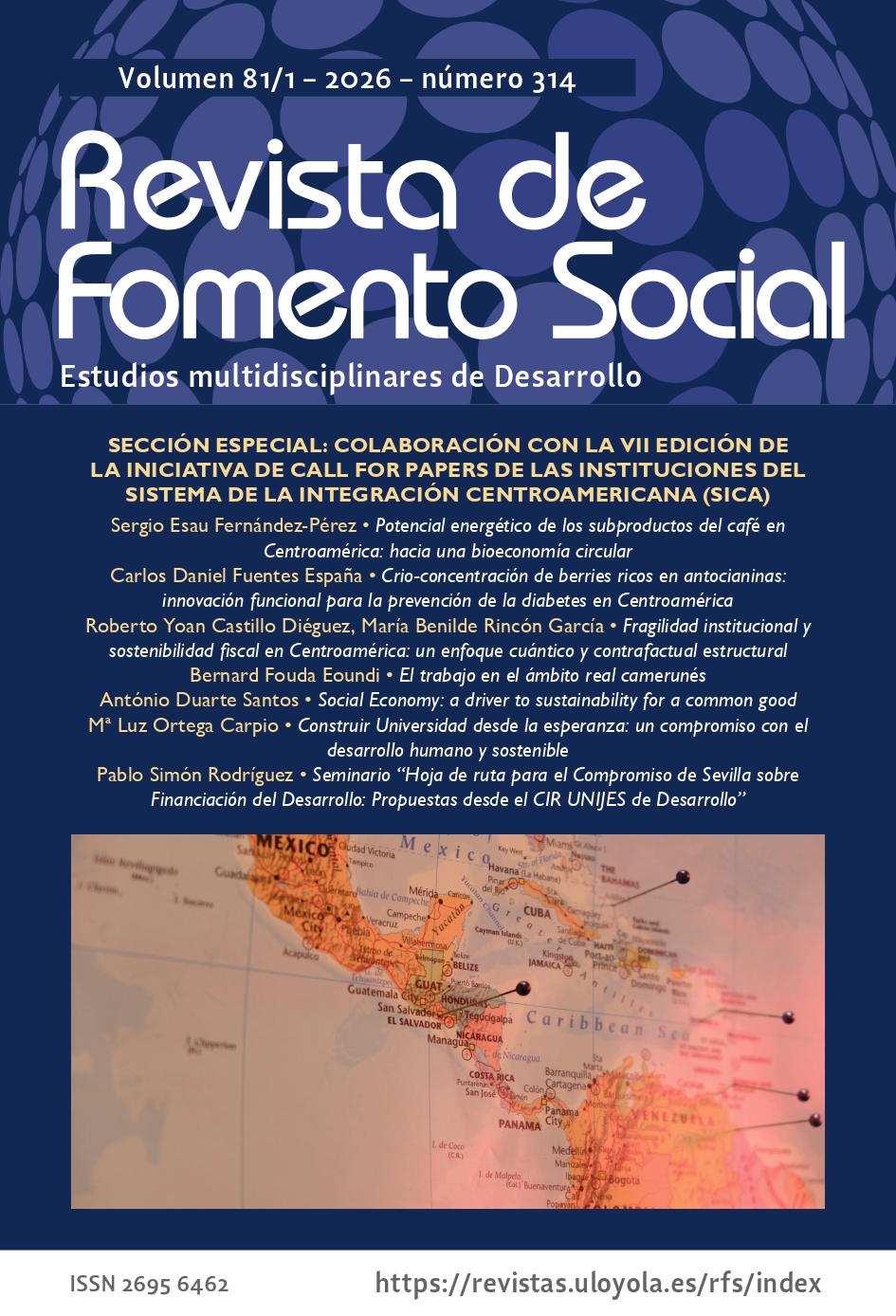
Main Article Content
Abstract
The study analyses institutional fragility and fiscal sustainability in the countries of the Central American Integration System (SICA) using a quantum and counterfactual approach. A functional model based on quantum field theory is developed to estimate metastable trajectories of sovereign fragility and identify critical transitions between stability regimes. Furthermore, a sovereign ESG index is constructed using factor analysis, and extended synthetic control is applied to assess the impact of institutional reforms and relevant events during 2008–2023. The results show that the quality of governance, control of corruption and social cohesion reduce fiscal vulnerability, whilst institutional weaknesses amplify the effects of external shocks. Taken together, the proposed model constitutes an empirical tool for anticipating scenarios of structural fragility and guiding policies for macro-institutional sustainability in Central America.
Downloads
Article Details

This work is licensed under a Creative Commons Attribution-NonCommercial-NoDerivatives 4.0 International License.
The authors acknowledge that the Revista de Fomento Social assumes as its own the intellectual property rights over their work and grant the journal the permissions of distribution and public communication of the same established in the Berlin, Bethesda and Budapest declarations; for this reason they accept that the work presented be distributed in open access, protecting the copyright under a "Creative Commons Attribution-NonCommercial-NoDerivativeWorks 4.0 (CC BY-NC-ND) license.

You may copy, use, disseminate, transmit and publicly display provided that:
Cite the authorship of the work, the publication in Revista de Fomento Social, issue, year and the pages where you found the information.
No commercial benefit may be obtained.
No derivative works may be made for commercial purposes that are not authorized by the journal.
Authors are encouraged to disseminate the article electronically (Revista de Fomento Social, number, year, pagination, ISSN, DOI, etc.), in order to favor its circulation and diffusion, increase its citation and reach among the academic community.
The information of the journal will be provided to Dulcinea
References
Abadie, A. (2021). Using Synthetic Controls: Feasibility, Data Requirements, and Methodological Aspects. Journal of Economic Literature, 59(2), 391–425. https://doi.org/10.1257/jel.20191450
Abadie, A., Diamond, A., & Hainmueller, J. (2010). Synthetic Control Methods for Comparative Case Studies: Estimating the Effect of California’s Tobacco Control Program. Journal of the American Statistical Association, 105(490), 493–505. https://doi.org/10.1198/jasa.2009.ap08746
Abadie, A., & Gardeazabal, J. (2003). The Economic Costs of Conflict: A Case Study of the Basque Country. American Economic Review, 93(1), 113–132. https://doi.org/10.1257/000282803321455188
Adhikari, B. (2022). A Guide to Using the Synthetic Control Method to Quantify the Effects of Shocks, Policies, and Shocking Policies. The American Economist, 67(1), 46–63. https://doi.org/10.1177/05694345211019714
Alaminos, D., Salas, M. B., & Fernández-Gámez, M. A. (2024). GLOBAL PATTERNS AND EXTREME EVENTS IN SOVEREIGN RISK PREMIA: A FUZZY S DEEP LEARNING COMPARATIVE. Technological and Economic Development of Economy, 30(3), 753–782. https://doi.org/10.3846/tede.2024.20488
Allison, P. D. (2009). Missing data. The SAGE Handbook of Quantitative Methods in Psychology, 23, 72–89.
Anand, A., Vanpée, R., & Lončarski, I. (2023). Sustainability and sovereign credit risk. International Review of Financial Analysis, 86, 102494. https://doi.org/10.1016/j.irfa.2023.102494
Ando, T., Greenwood-Nimmo, M., & Shin, Y. (2022). Quantile Connectedness: Modeling Tail Behavior in the Topology of Financial Networks. Management Science, 68(4), 2401–2431. https://doi.org/10.1287/mnsc.2021.3984
Andriyanov, N., Tashlinsky, A., & Dementiev, V. (2021). Detailed Clustering Based on Gaussian Mixture Models (pp. 437–448). https://doi.org/10.1007/978-3-030-55187-2_34
Baaquie, B. E. (2007). Quantum finance: Path integrals and Hamiltonians for options and interest rates. Cambridge University Press.
Barbier, E. B., & Burgess, J. C. (2021). Institutional Quality, Governance and Progress towards the SDGs. Sustainability, 13(21), 11798. https://doi.org/10.3390/su132111798
Barro, R. J., & Lee, J. W. (2013). A new data set of educational attainment in the world, 1950–2010. Journal of Development Economics, 104, 184–198. https://doi.org/10.1016/j.jdeveco.2012.10.001
Birlan, I., Davidescu, A. A., Tita, C.-E., & Nae, T. M. (2025). Modeling Regional ESG Performance in the European Union: A Partial Least Squares Approach to Sustainable Economic Systems. Mathematics, 13(15), 2337. https://doi.org/10.3390/math13152337
Boiciuc, I., & Orțan, D. (2020). Estimating the effects of fiscal policy on GDP growth in Romania in 2015-2017 using the synthetic control method. Post-Communist Economies, 32(6), 749–770. https://doi.org/10.1080/14631377.2020.1745559
Boitan, I. A. (2023). Fiscal sustainability in times of climate challenges: a multidimensional approach of the interlinkages between climate change and sovereign debt. Current Opinion in Environmental Sustainability, 65, 101387. https://doi.org/10.1016/j.cosust.2023.101387
Bonesini, O., Callegaro, G., & Jacquier, A. (2023). Functional quantization of rough volatility and applications to volatility derivatives. Quantitative Finance, 23(12), 1769–1792. https://doi.org/10.1080/14697688.2023.2273414
Bova, E., & Klyviene, V. (2020). Macroeconomic responses to fiscal shocks in Portugal. Journal of Economic Studies, 47(5), 1051–1069. https://doi.org/10.1108/JES-12-2018-0454
Capelle-Blancard, G., & Petit, A. (2019). Every Little Helps? ESG News and Stock Market Reaction. Journal of Business Ethics, 157(2), 543–565. https://doi.org/10.1007/s10551-017-3667-3
Cavallo, E., Galiani, S., Noy, I., & Pantano, J. (2013). Catastrophic Natural Disasters and Economic Growth. The Review of Economics and Statistics, 95(5), 1549–1561. https://doi.org/10.1162/REST_a_00413
Chari, A., Garcés, F., Martínez, J. F., & Valenzuela, P. (2024). Sovereign credit spreads, banking fragility, and global factors. Journal of Financial Stability, 72, 101235. https://doi.org/10.1016/j.jfs.2024.101235
Enders, C. K. (2022). Applied missing data analysis. Guilford Publications.
Ferman, B., & Pinto, C. (2021). Synthetic controls with imperfect pretreatment fit. Quantitative Economics, 12(4), 1197–1221. https://doi.org/10.3982/QE1596
Friede, G., Busch, T., & Bassen, A. (2015). ESG and financial performance: aggregated evidence from more than 2000 empirical studies. Journal of Sustainable Finance & Investment, 5(4), 210–233. https://doi.org/10.1080/20430795.2015.1118917
Gnimassoun, B., & Do Santos, I. (2021). Robust structural determinants of public deficits in developing countries. Applied Economics, 53(9), 1052–1076. https://doi.org/10.1080/00036846.2020.1824063
Gratcheva, E. (2024). Sovereign Environmental, Social, and Governance (ESG) Investing: Chasing Elusive Sustainability. IMF Working Papers, 2024(102), 1. https://doi.org/10.5089/9798400277054.001
Hair, J. F., Black, W. C., Babin, B. J., & Anderson, R. E. (2010). Multivariate data analysis: A global perspective (P. P. Hall, Ed.).
Haven, E., & Khrennikov, A. I. (2013). Quantum social science. Cambridge University Press.
Leung, C. K., Ko, J., & Chen, X. (2025). Economic crises and the erosion of sustainability: A global analysis of ESG performance in 100 countries (1990–2019). Innovation and Green Development, 4(2), 100226. https://doi.org/10.1016/j.igd.2025.100226
Little, R. J. A., & Rubin, D. B. (2019). Statistical analysis with missing data. John Wiley & Sons.
Little, R., & Rubin, D. (1987). Multiple imputation for nonresponse in surveys. Wiley, 10, 9780470316696.
Liu, Z., Cai, Z., Fang, Y., & Lin, M. (2020). Statistical Analysis and Evaluation of Macroeconomic Policies: A Selective Review. Applied Mathematics-A Journal of Chinese Universities, 35(1), 57–83. https://doi.org/10.1007/s11766-020-3775-1
Lozano, M. B., & Martínez-Ferrero, J. (2022). Do emerging and developed countries differ in terms of sustainable performance? Analysis of board, ownership and country-level factors. Research in International Business and Finance, 62, 101688. https://doi.org/10.1016/j.ribaf.2022.101688
Makridis, C. (2025). Toward a Quantum Model of Macroeconomic Stability: Tokenized Assets, Digital Twins, and Reduced Inflation. https://doi.org/10.2139/ssrn.5269697
Marín-Rodríguez, N. J., Gonzalez-Ruiz, J. D., & Botero, S. (2023). Assessing Fiscal Sustainability in the Landscape of Economics Research. Economies, 11(12), 300. https://doi.org/10.3390/economies11120300
Nagel, M. (2025). From vulnerability to stability? Latin American strategies to govern financial subordination. Competition & Change, 29(2), 163–182. https://doi.org/10.1177/10245294241313003
Nguyen, T. A. N., & Luong, T. T. H. (2021). Fiscal Policy, Institutional Quality, and Public Debt: Evidence from Transition Countries. Sustainability, 13(19), 10706. https://doi.org/10.3390/su131910706
Pascoal, F. B., Juwana, H., Karuniasa, M., & Djojokusumo, H. H. (2023). Sovereign ESG Integration: A Bibliometric and Systematic Literature Review. Studies in Business and Economics, 18(1), 231–260. https://doi.org/10.2478/sbe-2023-0013
Rahman, L., Rosten, J., Monroy, P., & Huang, S. (2021). Does ESG Matter for Sovereign Debt Investing? The Journal of Fixed Income, 31(1), 51–64. https://doi.org/10.3905/jfi.2021.1.112
Ramirez, A. G., Monsalve, J., González-Ruiz, J. D., Almonacid, P., & Peña, A. (2022). Relationship between the Cost of Capital and Environmental, Social, and Governance Scores: Evidence from Latin America. Sustainability, 14(9), 5012. https://doi.org/10.3390/su14095012
Schafer, J. L. (1997). Analysis of incomplete multivariate data. CRC press.
Segura, L. D., van Zeijl‐Rozema, A., & Martens, P. (2022). Climate change adaptation in Central America: A review of the national policy efforts. Latin American Policy, 13(2), 276–327. https://doi.org/10.1111/lamp.12277
Semet, R., Roncalli, T., & Stagnol, L. (2021). ESG and Sovereign Risk: What is Priced in by the Bond Market and Credit Rating Agencies? SSRN Electronic Journal. https://doi.org/10.2139/ssrn.3940945
Skavysh, V., Priazhkina, S., Guala, D., & Bromley, T. R. (2023). Quantum monte carlo for economics: Stress testing and macroeconomic deep learning. Journal of Economic Dynamics and Control, 153, 104680. https://doi.org/10.1016/j.jedc.2023.104680
Sorokina, N., Booth, D. E., & Thornton, J. H. (2021). Robust Methods in Event Studies: Empirical Evidence and Theoretical Implications. Journal of Data Science, 11(3), 575–606. https://doi.org/10.6339/JDS.2013.11(3).1166
Williams, C. F. (2025). Diagnosing Strategic Fragility: A Causal Simulation Approach to Value Flow Disruption. https://doi.org/10.2139/ssrn.5277550
Xafa, M. (2023). Sovereign Debt Restructuring: The Way Forward. Journal of Globalization and Development, 13(2), 435–474. https://doi.org/10.1515/jgd-2021-0070