
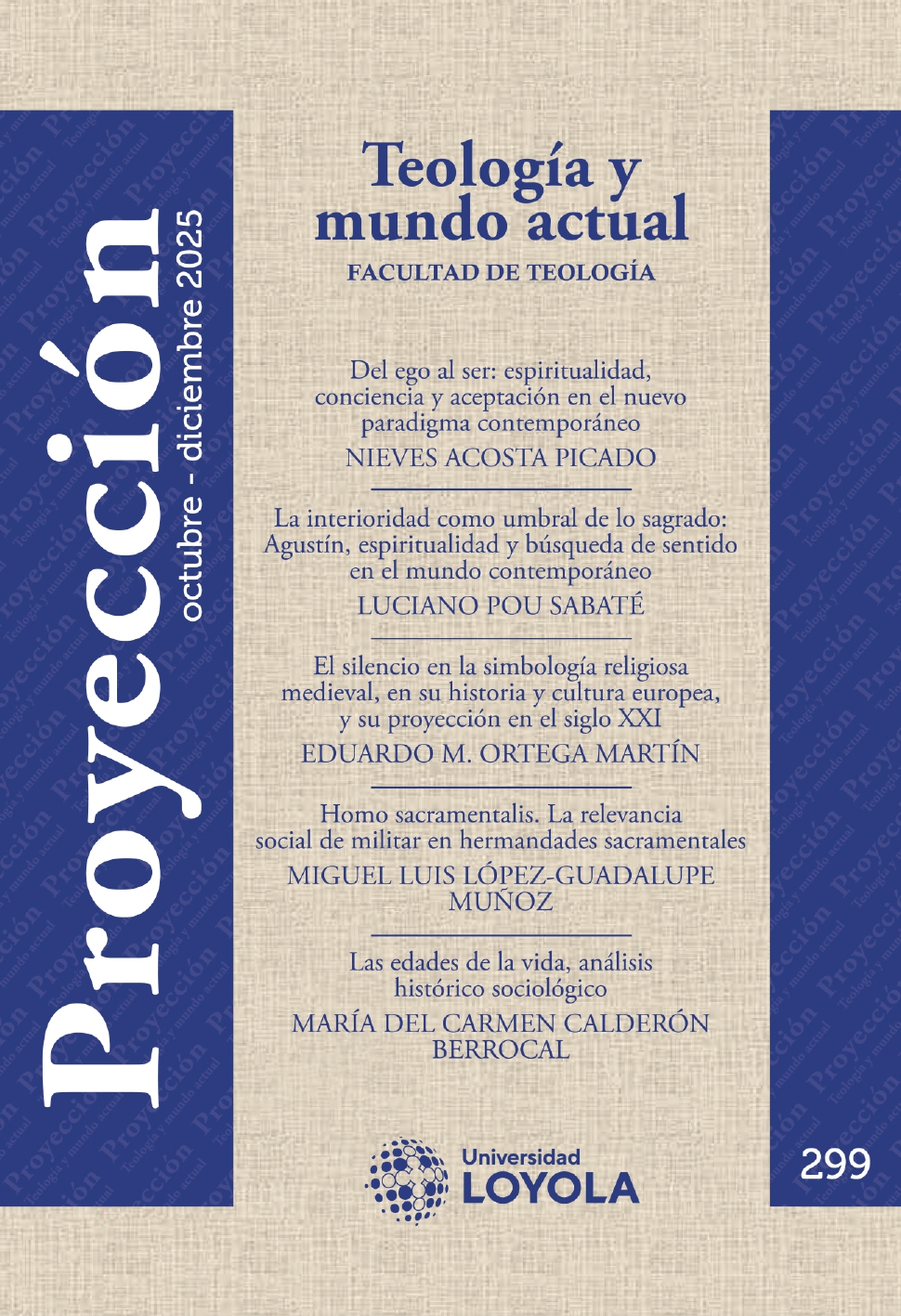
The ages of life, historical sociological analysis from the perspective of philosophy and religiosity
Article Sidebar
Main Article Content
Abstract
The notion of youth is part of the intellectual heritage of every society, although it is conceptualized in different ways. Age is one of the variables around which an individual's definition can be constructed. In this way, the transition from one stage of life to another is marked by a series of rites and the acquisition of institutional prerogatives that increase as one moves from one period of life to another. Youth, as a bridge between the stages of childhood and maturity, is characterized by a higher level of social acquisitions compared to the preceding period, childhood, which is considered incomplete. Even so, young people are still denied access to certain prerogatives specific to mature age.
Downloads
Article Details

This work is licensed under a Creative Commons Attribution-NonCommercial-NoDerivatives 4.0 International License.
Previously, the journal was copyrighted. Now, since 2021, the journal publishes under the Creative Commons license.
Authors who publish in Proyección. Teología y Mundo Actual, accept the following conditions:
Authors retain copyright © and grant the journal the right of publication, under Creative Commons Attribution-NonCommercial-NoDerivativeWorks 4.0 (CC BY-NC-ND) license.
You may copy, use, disseminate, transmit, and publicly display provided that:
* Cite authorship of the work, publication in Proyección. Teología y Mundo Actual, number, year and the pages where the information was found.
* No commercial benefit may be obtained.
* No derivative works may be made for commercial purposes that are not authorized by the journal.
Authors are allowed and encouraged to disseminate the article electronically (Proyección. Teología y Mundo Actual, logo or cover of the journal, pagination, indication of the volume and number of the journal, ISSN, DOI, etc.), in order to favor its circulation and diffusion, and to increase its citation and reach among the academic community.
References
ALFONSO X, Las siete partidas (7 vols.), Gregorio LÓPEZ (ed.), Madrid, 1981 (ed. facs. de la de Salamanca, 1987).
ARIÈS, Philippe (1981), El niño y la vida familiar en el Antiguo Régimen, Madrid.
BARRIENTOS, Lope, Refundición de la Crónica del Halconero, Juan de Mata CARRIAZO (ed.), Madrid, 1982 (1ª ed.).
BEAUVOIR, Simone de: El segundo sexo . Editorial Siglo XXI, 1949.
BECEIRO PITA, Isabel (2003), «Educación y cultura en la nobleza (siglos XIII-XV)», Anuario de Estudios Medievales, 34, pp. 337-372.
BECEIRO PITA, Isabel (2004), «Entre el ámbito privado y las competencias públicas: la educación en el reino de Castilla (siglos XIII-XV)», en José María SOTO RÁBANOS (coord.), Pensamiento medieval hispano. Homenaje a Horacio Santiago-Otero (4 vols.), Madrid, vol. 1, pp. 535-573.
BECEIRO PITA, Isabel (2011), «La educación: un derecho y un deber del cortesano», en José-Ignacio de la IGLESIA DUARTE (coord.), La enseñanza en la Edad Media. X Semana de Estudios Medievales (Nájera, 2011), Logroño, pp. 159-182.
BENEYTO PÉREZ, Juan (ed.) (1985), Glosa castellana al «Regimiento de Príncipes» de Egidio Romano (2 vols.), Madrid.
CHACÓN, Gonzalo, Crónica de don Álvaro de Luna, condestable de Castilla, Juan de Mata CARRIAZO y Arroquia (ed. y estudio), Madrid, 1982.
CONDE, Juan Carlos (ed.) (2000), La creación de un discurso historiográfico en el Cuatrocientos castellano. «Las siete edades del mundo» de Pablo de Santa María (estudio y edición crítica), Salamanca (1.ª ed.).
CROUZET-PAVAN, Elizabeth (2001), «Una flor del mal: los jóvenes en la Italia medieval (siglos XIII al XV)», en Giovanni Levi y Jean-Claude Schmitt (dirs.), Historia de los jóvenes (5 vols.), vol. 1: De la Antigüedad a la Edad Moderna, Madrid, pp. 69-107.
ECHEVARRÍA ARSUAGA, Ana (1995), Catalina de Lancaster. Reina regente de Castilla (1415-1461), Hondarribia (Guipúzcoa).
FABIETTI, Ugo (2001), «La “construction” de la jeunesse. Une perspective anthropologique», en Historicité de l’enfance et de la jeunesse. Actes du colloque international, Atenas, pp. 21-51.
FUKUYAMA, Francis: La mujer y la evolución de la sociedad . Editorial Planeta, 1998.
GARCÍA DE SANTA MARÍA, Álvar, Crónica de Juan II de Castilla, Juan de Mata Carriazoy Arroquia (ed.), Madrid, 2004.
GARCÍA REY, Verardo (2000), La famosa priora doña Teresa de Ayala (su correspondencia íntima con los monarcas de su tiempo), Madrid.
GIL DE ROMA (Egidio Romano o Colonna), Regimiento de príncipes, [siglo XV], (Biblioteca del Monasterio de San Lorenzo de El Escorial, Ms.K.I. 5).
GOLDMAN, Emma: La mujer y el socialismo . Editorial Losada, 1906.
GÓMEZ REDONDO, Fernando (1990-1995), Historia de la prosa medieval castellana (5 vols.), Madrid.
HARRIS, Anne: Las mujeres y el envejecimiento: Un enfoque histórico . Editorial Del Este, 2012.
HAUSER, Hermann: Historia social de la mujer . Editorial Critica, 1991.
DON JUAN MANUEL (Infante de Castilla), Cinco tratados, Ricardo Ayerbe-Chaux (ed.), Madison, 2002.
DON JUAN MANUEL, El libro de los estados, Ian R. Macpherson y Robert Brian Tate (eds.), Madrid, 2001.
KÜHL, Stefan: El fin de la vejez: La revolución de la longevidad en la sociedad moderna . Ediciones Akal, 2017.
LASLETT, Peter: A Fresh Map of Life: The Emergence of the Third Age . Harvard University Press, 1989.
LE GOFF, Jacques (2001), «Le rôle de l’enfant dans l’idéologie monarchique de l’occident médiéval», en Historicité de l’enfance et de la jeunesse. Actes du colloque international, Atenas, pp. 67-86.
LIND, Sara: Mujeres en la historia: una visión global . Editorial Alianza, 1995.
LÓPEZ DE AYALA, Pedro, Crónicas de los Reyes de Castilla. Desde don Alfonso el Sabio hasta los Católicos don Fernando y doña Isabel (8 vols.), Cayetano Rosell (ed.), Madrid, vol. 5, 2000.
LÓPEZ DE AYALA, Pedro, Corónica de Enrique III, Constance Lee Wilkins y Heanon M. Wilkins (eds.), Madison, 2002.
MORGAN, K.: La mujer en la Edad Moderna. Editorial Akal, 2014.
MORRISON, Toni: The Bluest Eye . Alfred A. Knopf, 1970.
ORME, Nicholas (1984), From Childhood to Chivalry. The Education of the English Kings and Aristocracy (1485-1660), Londres.
PASTOR, Reyna (2001), «Rôle et image de la “juventus” dans l’Espagne médiévale», en Historicité de l’enfance et de la jeunesse. Actes du colloque international, Atenas, pp. 95-115.
PASTOREAU, Michel (2001), «Los emblemas de la juventud. Atributos y formas de representación de los jóvenes en la imagen medieval», en Giovanni Levi y Jean-Claude Schmitt (dir.), Historia de los jóvenes (5 vols.), vol. 1: De la Antigüedad a la Edad Moderna, Madrid, pp. 123-160.
PULGAR, Fernandodel (1980), Claros varones de Castilla, Buenos Aires.
ROGER, Philippe: La Edad Media y sus percepciones de la edad humana . Editorial Crítica, 1994.
SCONZA, M. Jean (2003), History and Literature in Fifteenth Century Spain. An Edition and Study of Pablo de Santa María’s «Siete edades del mundo», Madison.
SCOTT, Joan W. : Gender and the Politics of History . Columbia University Press, 1988.
SILVA, José Gentilda (2001), «L’historicité de l’enfance et de la jeunesse», en Historicité de l’enfance et de la jeunesse. Actes du colloque international, Atenas, pp. 147-171.
SHALIT, Ronald: The Age of Women: Gender and Aging in the Modern World . Harper & Row, 1993.
TOBIES, Sigrid: La mujer en el pensamiento filosófico moderno: Desde Descartes hasta la Ilustración . Editorial Trotta, 2004.
TORRES FONTES, Juan (1986), «La regencia de don Fernando de Antequera», Anuario de Estudios Medievales, 16, pp. 367-401.
WILKINSON, R. G. y PICKETT, K: La batalla de la vida: la desigualdad en la sociedad moderna . Editorial Taurus, 2010.
WOLLSTONECRAFT, Mary: Una vindicación de los derechos de la mujer . Editorial Cátedra, 1792.
YARZA LUACES, Joaquín (1992), «Hombres de poder, gentes del libro, “viri litterati” y encargos artísticos», en El marqués de Santillana (1398-1458). Los albores de la España moderna (6 vols.), vol. 2: El Humanista, Hondarribia (Guipúzcoa), pp. 1-102.
YOUNG, Iris Marion: Mujeres, cultura y política . Editorial Siglo XXI, 1984.