
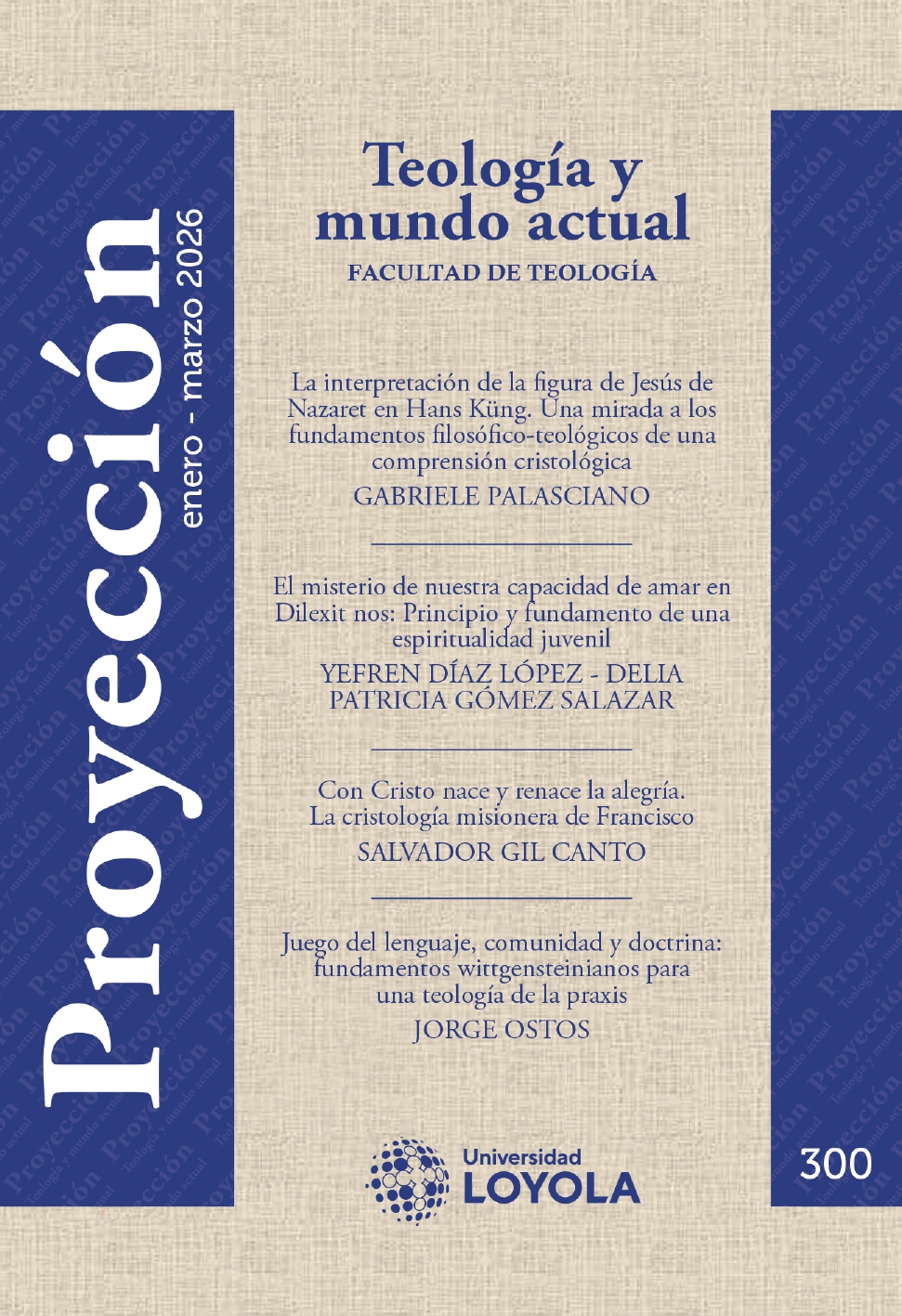
Language Game, Community, and Doctrine Wittgensteinian foundations for a theology of praxis
Article Sidebar
Main Article Content
Abstract
This article examines how Ludwig Wittgenstein’s later philosophy—particularly the notions of “language game” and “form of life”—provides foundations for rethinking Christian theology as communal praxis. It argues that the meaning of religious language emerges from use in shared practices, challenging both the traditional representationalist model and soteriological individualism. Drawing on Wittgenstein’s private language argument, the article shows that Christian faith is inherently communal for principled reasons, not merely pastoral convenience. Furthermore, it offers a critical appropriation of George Lindbeck’s cultural-linguistic model, acknowledging its contributions while identifying its limitations in light of a closer reading of Wittgenstein. The article concludes that theology, understood as a form of life, is constructed through liturgical interaction and ecclesial mediation, where doctrines function not as a closed system but as the living grammar of faith.
Downloads
Article Details

This work is licensed under a Creative Commons Attribution-NonCommercial-NoDerivatives 4.0 International License.
Previously, the journal was copyrighted. Now, since 2021, the journal publishes under the Creative Commons license.
Authors who publish in Proyección. Teología y Mundo Actual, accept the following conditions:
Authors retain copyright © and grant the journal the right of publication, under Creative Commons Attribution-NonCommercial-NoDerivativeWorks 4.0 (CC BY-NC-ND) license.
You may copy, use, disseminate, transmit, and publicly display provided that:
* Cite authorship of the work, publication in Proyección. Teología y Mundo Actual, number, year and the pages where the information was found.
* No commercial benefit may be obtained.
* No derivative works may be made for commercial purposes that are not authorized by the journal.
Authors are allowed and encouraged to disseminate the article electronically (Proyección. Teología y Mundo Actual, logo or cover of the journal, pagination, indication of the volume and number of the journal, ISSN, DOI, etc.), in order to favor its circulation and diffusion, and to increase its citation and reach among the academic community.
References
B. R. Ashford, «Wittgenstein's Theologians? A Survey Of Ludwig Wittgenstein's Impact On Theology»: JETS 50 (2007) 357-375.
J. L. Austin, Cómo hacer cosas con palabras, Grupo Anaya, Barcelona 2016.
P. Bourdieu, El sentido práctico, Siglo XXI, Ciudad de México 2009.
J. D. Caputo, Philosophy and Theology, Abingdon Press, Nashville 2006.
G. Florovsky, Bible, Church, Tradition: An Eastern Orthodox View, Nordland Publishing Company, Belmont 1972.
G. Florovsky, «Scripture and Tradition: An Orthodox Point of View»: Dialog 2 (1963) 288-293.
A. C. Grayling, Wittgenstein: A Very Short Introduction, Oxford University Press, Oxford 2001.
C. Gschwandtner, «What Has Paris to Do With Byzantium?»: The Wheel 4 (2016) 32-37.
M. Haslam, «Language as Expression: A Wittgensteinian Critique of the Cultural-Linguistic Approach to Religion»: American Journal of Theology & Philosophy 28 (2007) 237-250.
F. Kerr, Theology After Wittgenstein, SPCK, Londres 1997.
M. Kusch, Knowledge by Agreement, Oxford University Press, Nueva York 2002.
J. F. Lyotard, The Postmodern Condition: A Report on Knowledge, University of Minnesota Press, Minneapolis 1984.
A. Macintyre, After Virtue: A Study in Moral Theory, University of Notre Dame Press, Notre Dame 2007.
M. Merleau-Ponty, Fenomenología de la percepción, Península, Barcelona 1975.
J. Ostos, «La oración cristiana como juego de lenguaje: Una aproximación wittgensteniana»: Revista Interdisciplinaria de Teología 3 (2025) 55-63.
J. Ostos, «Palabra encarnada y juego eucarístico. Cristología calcedoniana y Wittgenstein en la praxis ortodoxa»: Teología y cultura 27 (2025) 151-173.
J. Ostos, Wittgenstein responde: 31 respuestas hipotéticas sobre fe cristiana, Worldview Media Publishing, Atlanta 2026.
J. Ostos – S. Sarabia, Fe encarnada: Diálogos con la filosofía posmoderna, Editorial Clie, Barcelona 2026.
D. Z. Phillips, The Concept of Prayer, Schocken Books, Nueva York 1966.
M. Polanyi, Personal Knowledge: Towards a Post-Critical Philosophy, University of Chicago Press, Chicago 1974.
M. Polanyi, The Tacit Dimension, University of Chicago Press, Chicago 2009.
J. Searle, Actos de habla: Ensayo de filosofía del lenguaje, Grupo Anaya, Barcelona 2017.
J. K. A. Smith, Imaging the Kingdom: How Worship Works, Baker Academic, Grand Rapids 2013.
K. J. Vanhoozer, El drama de la doctrina: Una perspectiva canónico-lingüística de la teología cristiana, Ediciones Sígueme, Salamanca 2010.
K. Ware, La Iglesia Ortodoxa, Editorial Ángela, Buenos Aires 2006.
T. H. Warren, Liturgy of the Ordinary: Sacred Practices in Everyday Life, InterVarsity Press, Downers Grove 2016.
L. Wittgenstein, Investigaciones filosóficas, Trotta, Madrid 2021.
L. Wittgenstein, Tractatus logico-Philosophicus, Tecnos, Madrid 2022.
J. Zizioulas, The Orthodox Church and the Third Millennium (en línea), Líbano 1999. Recuperado de: http://theology.balamand.edu.lb/index.php/local-events/738-zizioulaslecture (consulta: 4 de febrero de 2025).