
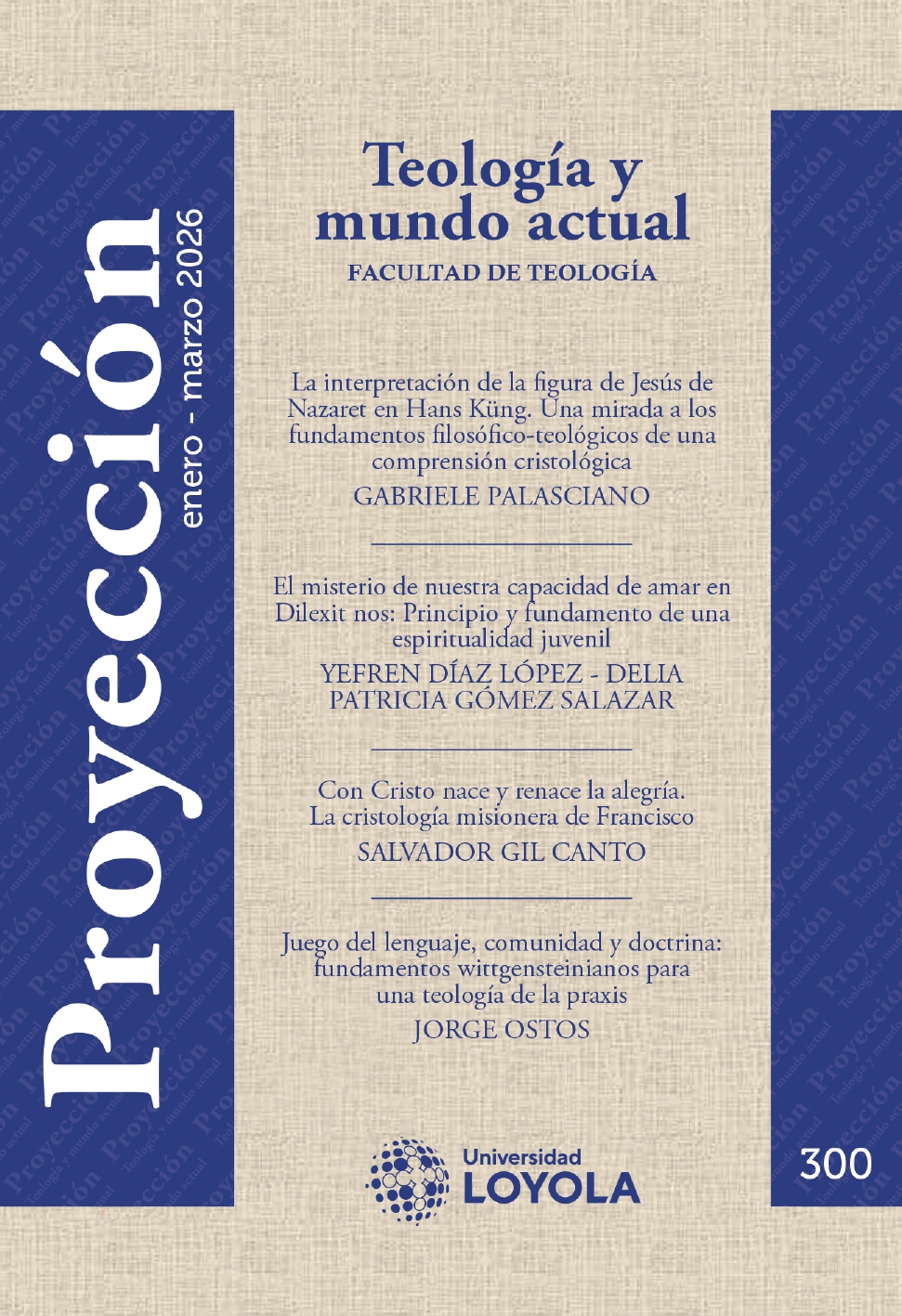
The interpretation of the figure of Jesus of Nazareth in Hans Küng A view of the philosophical-theological foundations of a christological understanding
Article Sidebar
Main Article Content
Abstract
Jesus of Nazareth, known as the Christ and Son of God by the ecclesial community, has always been at the center of several discussions. Within Christianity, theological reflection has been trying to address the question concerning both the Jesuan identity and the Gospel message. It has been accomplishing this by confronting, more specifically, historical-critical exegesis, the results of which sometimes make it necessary to define or redefine the foundations of Christianity in recent times. This is the context in which Hans Küng presents a Christology that, drawn up from the confrontation with philosophy on the one hand, especially Hegelian philosophy, and historical research on the other, focuses on the humanity of Jesus, as well as his properly biblical and historical role as an envoy of God. The article seeks to present the origin of Küng’s Christological interest, delving into the ways in which Hegelian thought influenced his Christological elaboration, thereby helping to define the limits of any future Christology. Moreover, a proper understanding of the scope of Küng’s proposal enables it to be placed accurately within the current theological reflection.
Downloads
Article Details

This work is licensed under a Creative Commons Attribution-NonCommercial-NoDerivatives 4.0 International License.
Previously, the journal was copyrighted. Now, since 2021, the journal publishes under the Creative Commons license.
Authors who publish in Proyección. Teología y Mundo Actual, accept the following conditions:
Authors retain copyright © and grant the journal the right of publication, under Creative Commons Attribution-NonCommercial-NoDerivativeWorks 4.0 (CC BY-NC-ND) license.
You may copy, use, disseminate, transmit, and publicly display provided that:
* Cite authorship of the work, publication in Proyección. Teología y Mundo Actual, number, year and the pages where the information was found.
* No commercial benefit may be obtained.
* No derivative works may be made for commercial purposes that are not authorized by the journal.
Authors are allowed and encouraged to disseminate the article electronically (Proyección. Teología y Mundo Actual, logo or cover of the journal, pagination, indication of the volume and number of the journal, ISSN, DOI, etc.), in order to favor its circulation and diffusion, and to increase its citation and reach among the academic community.
References
A. AMATO, Gesù è il Signore. Saggio di cristologia, Dehoniane, Bologna 1988.
D. ANSORGE, Kleine Geschichte der christlichen Theologie. Epochen, Denker, Weichenstellungen, Pustet, Regensburg 2017, 279-281.
J. AUER, Jesus Christus – Gottes und Mariä “Sohn”, Pustet, Regensburg 1986;
ID., Christus – Heiland der Welt, Pustet, Regensburg 1988.
H.U. VON BALTHASAR, Theologie der drei Tage, Johannes Verlag, Einsiedeln 1990.
P. BARTHEL, “«Être chrétien» de Hans Küng. Essai de lecture critique de l’herméneutique de quelques titres et représentations christologiques néotestamentaires proposées par l’auteur”: Revue de théologie et de philosophie 110 (1978) 225-248.
J. BECKER, Jesus von Nazaret, De Gruyter, Berlin-New York 1996
H. BERKHOF, Christian Faith: An Introduction to the Study of the Faith, William B. Eerdmans, Grand Rapids 19862.
W. BRUGGER, Summe einer philosophischen Gotteslehre, Johannes Berchmans, München 1979.
D. COMPOSTA, “Cristologia e false cristologie”: Divinitas 3 (1977) 408-409.
E. CORETH, Gott im philosophischen Denken, Kohlhammer, Stuttgart 2001.
J.D. CROSSAN, The Historical Jesus: The Life of a Mediterranean Jewish Peasant, Harper, San Francisco 1991.
C.J. DEN HEYER, La storicità di Gesù, Claudiana, Torino 2000.
W. DESMOND, Hegel’s God. A Counterfeit Double?, Routledge, London 2003.
M. EBNER, Jesus von Nazaret in seiner Zeit. Sozialgeschichtliche Zugänge, Katholisches Bibelwerk, Stuttgart 2003.
E.L. FACKENHEIM, The Religious Dimension in Hegel’s Thought, Indiana University Press, Bloomington 1967.
B. FORTE, Gesù di Nazaret, storia di Dio, Dio della storia. Saggio di una cristologia come storia, San Paolo, Cinisello Balsamo 2007.
M. FRAIJÓ, Momentos estelares en la historia del pensamiento cristiano. Escritos sobre religión y filosofía, Trotta, Madrid 2024.
J. GALOT, “Christologie: approches diverses”, en R. LATOURELLE, R. FISICHELLA (eds.), Dictionnaire de théologie fondamentale, Bellarmin-Cerf, Montréal-Paris 1992, 173-180.
R. GIBELLINI, “La teologia di Piet Schoonenberg e il suo progetto cristologico. Indicazioni bibliografiche”, en L. BAKKER, T. VAN BAVEL, H. BERKHOF, F. HAARSMA, P. SCHOONENBERG (eds.), La teologia di Piet Schoonenberg, Queriniana, Brescia 1973, 9-16
J. GNILKA, Jesus von Nazaret. Botschaft und Geschichte, Herder, Freiburg i.B.-Basel-Wien 1990.
F. GOGARTEN, Jesus Christus, Wende der Welt. Grundfragen zur Christologie, Mohr, Tübingen 1966.
O. GONZÁLEZ DE CARDEDAL, Jesús de Nazaret. Aproximación a la cristología, Biblioteca de autores cristianos, Madrid 19782.
T.H. GRAVES, “The Functional Christology of Hans Küng”: Perspectives in Religious Studies 1 (1981) 59-61.
H.-M. GUINDON, “«L’être chrétien» selon Hans Küng”: Laval théologique et philosophique 35 (1979) 289-299.
J.A. GUTIÉRREZ SOLER, “Neokantismo, Ilustración y Religión en el joven Hegel, en las obras de Jena de 1801 y 1802”: Ciencia Tomista 151 (2024) 491-507.
P.C. HODGSON, Hegel and Christian Theology: A Reading of the Lectures on the Philosophy of Religion, Oxford University Press, Oxford 2005.
W. HOMOLKA, Der Jude Jesus – eine Heimholung, Herder, Freiburg i.B.-Basel-Wien 2020.
H. HOPING, Einführung in die Christologie, Wissenschaftliche Buchgesellschaft, Darmstadt 2004.
ID., Jesus aus Galiläa. Messias und Gottes Sohn, Freiburg i.B.-Basel-Wien 2019.
V. HÖSLE, Il concetto di filosofia della religione in Hegel, La scuola di Pitagora, Napoli 2006.
W. JAESCHKE, Reason in Religion: The Foundations of Hegel’s Philosophy of Religion, University of California Press, Berkeley 1990.
J.S. KSELMANN, R.D. WITHERUP, “Modern New Testament criticism”, en R.E. BROWN, J.A. FITZMYER, R.E. MURPHY (eds.), The New Jerome Biblical Commentary, Pearson, London 2000, 1130-1145.
H. KÜNG, Menschwerdung Gottes. Eine Einführung in Hegels theologisches Denken als Prolegomena zu einer künftigen Christologie [1970], Piper, München 1989.
ID., Was in der Kirche bleiben muß [1973], Benziger, Einsiedeln 19754.
ID., Christ sein [1974], Piper, München 20106.
ID., 20 Thesen zum Christsein [1975], Piper, München 19816.
ID., Theologie im Aufbruch. Eine ökumenische Grundlegung, Piper, München 1987,
ID., Das Christentum. Die religiöse Situation der Zeit [1994], Piper, München 20032.
ID., Spurensuche. Die Weltreligionen auf dem Weg [1999], Piper, München 20132.
K.-J. KUSCHEL, “Theologie in Freiheit. Grunddimensionen der Theologie von Hans Küng”, en ID., W. JENS, Dialog mit Hans Küng. Mit der Abschiedsvorlesung von Hans Küng, Piper, München 1996, 25-32.
K. LEHMKÜHLER, “Le théologien Wolfhart Pannenberg dans le contexte de la théologie protestante du XXème siècle”: Revue des sciences religieuses 83/3 (2009) 418-420.
G. LOHFINK, Jesus von Nazaret. Was er wollte, wer er war, Herder, Freiburg i.B.-Basel-Wien 2011.
V. MANCUSO, Hegel teologo e l’imperdonabile assenza del «Principe di questo mondo» [1996], Garzanti, Milano 2018.
F.W. MARQUARDT, Verwegenheiten. Theologische Stücke aus Berlin, Kaiser, München, 1981.
ID., Die Gegenwart des Auferstandenen bei seinem Volk Israel. Ein dogmatisches Experiment, Kaiser, München 1983.
ID., Das christliche Bekenntnis zu Jesus, dem Juden. Eine Christologie, voll. 1-2, Kaiser, München 1990-1991.
J.B. METZ, Jenseits bürgerlicher Religion. Reden über die Zukunft des Christentums, Kaiser, München 1980;
J. MOLTMANN, Der gekreuzigte Gott. Das Kreuz Christi als Grund und Kritik christlicher Theologie, Kaiser, München 1972.
B. MONDIN, Le cristologie moderne, Paoline, Roma 19762.
ID., “L’esperimento cristologico di Hans Küng”: Biblical Theology Bulletin 2 (1977) 86-87.
U. NEUENSCHWANDER, Gott im neuzeitlichen Denken, vol. 1, Gütersloher, Gütersloh 1977.
G. PALASCIANO, “Apostilla sobre el «jesuanismo» propuesto por el historiador Mauro Pesce para el siglo XXI”: Ciencia Tomista 151 (2024) 353-388.
W. PANNENBERG, Grundzüge der Christologie, Gütersloher Verlagshaus Gerd Mohn, Gütersloh 1964.
ID., Gottesgedanke und menschliche Freiheit, Vandenhoeck & Ruprecht, Göttingen 1972.
T. PINKARD, Hegel: A Biography, Cambridge University Press, Cambridge 2000.
P. PIOVANELLI, Le Jésus des historiens. Entre vérité et légende, Presses universitaires de France, Paris 2023.
A. RIZZI, Cristo verità dell’uomo. Saggio di cristologia fenomenologica, Cittadella, Assisi 2010.
L. SCHENKE, Jesus vor dem Dogma. Zur inneren Überzeugungskraft der Worte Jesu, Kohlhammer, Stuttgart 2014.
E. SCHILLEBEECKX, Jezus. Het verhaal van een levende, Nelissen, Bloemendaal 1974.
J. SCHRÖTER, Jesus von Nazaret. Jude aus Galiläa – Retter der Welt, Evangelischen Verlagsanstalt, Leipzig 2006.
M. SECKLER, “Die Aufklärung – eine Herausforderung für das Christentum als Offenbarungsreligion”, en W. KERN (ed.), Aufklärung und Gottesglaube, Patmos, Düsseldorf 1981, 51-66.
M. SERENTHÀ, Gesù Cristo ieri, oggi e sempre. Saggio di cristologia, Elledici, Torino 19965.
J. SOBRINO, Jesús en América Latina. Su significado para la fe y la cristología, Sal Terrae, Santander 1982.
T.A. STEFANO, “Christology from Lessing to Schleiermacher”, en F.A. MURPHY (ed.), The Oxford Handbook of Christology, Oxford University Press, Oxford 2015, 347-361.
T. TANKE, Bewusste Religion. Eine Konstellationsskizze zum jungen Hegel, Pustet, Regensburg 2012.
A. TASSI, Teologia e Aufklärung. Le radici del giovane Hegel, La Città del Sole, Napoli 1998.
G. THEISSEN, A. MERZ, Der historische Jesus. Ein Lehrbuch, Vandenhoeck & Ruprecht, Göttingen 1996.
X. TILLIETTE, Le Christ de la philosophie. Prolégomènes à une christologie philosophique, Cerf, Paris 1990.
ID., “Introduction. Les philosophes et leur Christ”, en AA.VV., Il cristo dei filosofi, Herder-EMF, Roma 1995, 5-19.
W. WEISCHEDEL, Der Gott der Philosophen. Grundlegung einer philosophischen Theologie im Zeitalter des Nihilismus, vol. 1, Wissenschaftliche Buchgesellschaft, Darmstadt 19943.
R.R. WILLIAMS, Hegel on the Proofs and the Personhood of God: Studies in Hegel’s Logic and Philosophy of Religion, Oxford University Press, Oxford 2017.
W. WÜNSCH, “Christologie im Schatten eines Weltstars – der historische Jesus und die Ernte bei Hans Küng”: Forum Katholische Theologie 4 (2021) 301-317.