
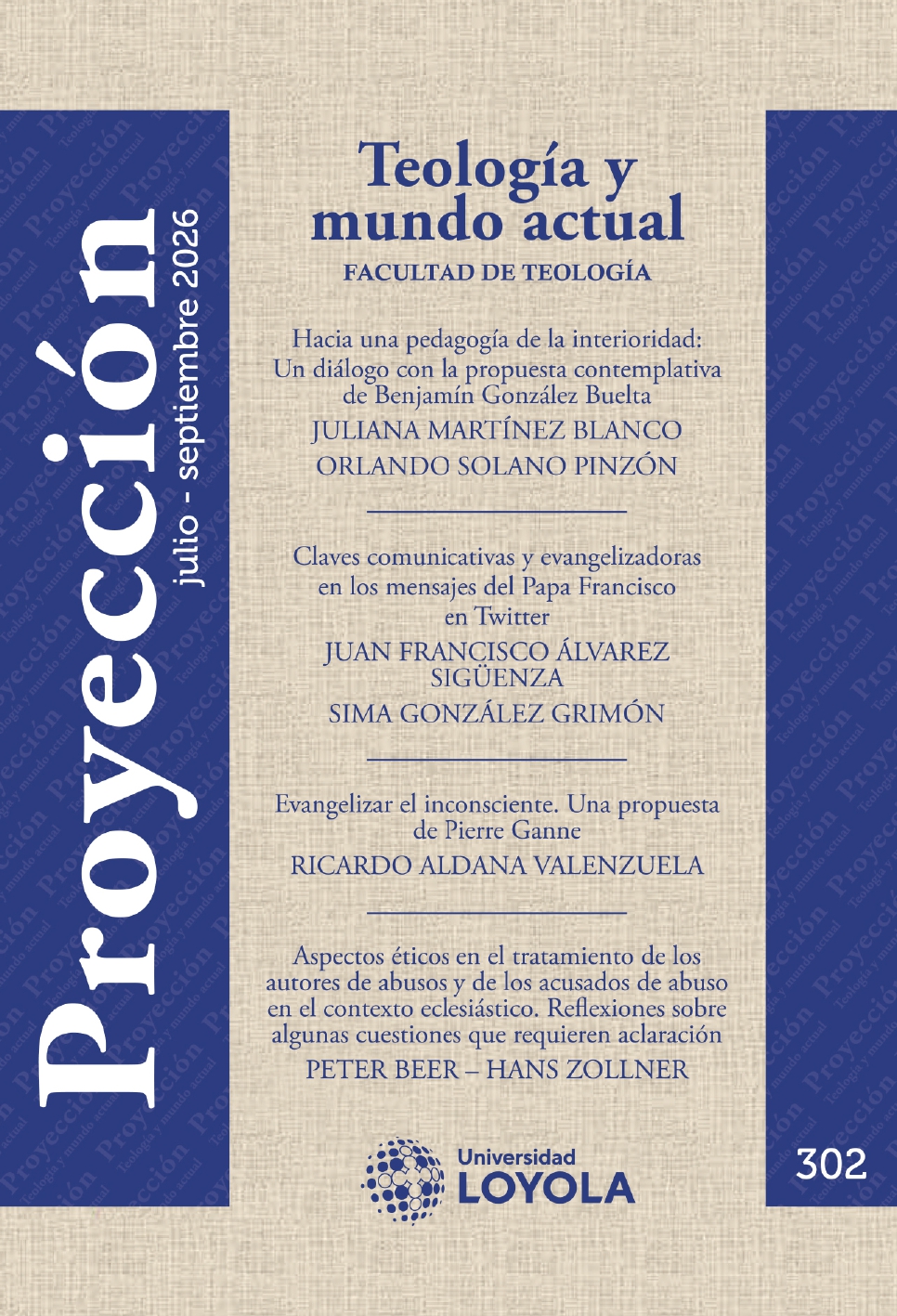
Hacia una pedagogía de la interioridad Un diálogo con la propuesta contemplativa de Benjamín González Buelta
Article Sidebar
Main Article Content
Abstract
This paper proposes a comprehensive approach to accompanying university students, articulating the search for meaning in life with the spiritual dimension, in dialogue with the contemplative proposal of Benjamín González Buelta. Its central contribution lies in recognizing that the classroom can become a space for personal transformation, where young people reframe from their life experiences through dialogue, empathetic listening, and inner reflection. Through a testimonial and theoretical methodology, it addresses contemporary issues such as depression, eating disorders, substance use, suicide, and identity crises, highlighting how these affect the emotional, social, and spiritual well-being of young people. The importance of integrating educational practices that foster spiritual intelligence, contemplation in action, and a pedagogy of meaning—understood as an ethic of care and the promotion of hope—is emphasized. The text argues that spiritual accompaniment does not replace clinical intervention but complements it, offering spaces of meaning where young people can reconnect with themselves and with the transcendent. Contemplation, according to González Buelta, is lived in the everyday, transforming reality through a renewed sensitivity. Thus, education is presented as a theological space, where the human and the divine intertwine in the construction of a full and meaningful life.
Downloads
Article Details

This work is licensed under a Creative Commons Attribution-NonCommercial-NoDerivatives 4.0 International License.
Previously, the journal was copyrighted. Now, since 2021, the journal publishes under the Creative Commons license.
Authors who publish in Proyección. Teología y Mundo Actual, accept the following conditions:
Authors retain copyright © and grant the journal the right of publication, under Creative Commons Attribution-NonCommercial-NoDerivativeWorks 4.0 (CC BY-NC-ND) license.
You may copy, use, disseminate, transmit, and publicly display provided that:
* Cite authorship of the work, publication in Proyección. Teología y Mundo Actual, number, year and the pages where the information was found.
* No commercial benefit may be obtained.
* No derivative works may be made for commercial purposes that are not authorized by the journal.
Authors are allowed and encouraged to disseminate the article electronically (Proyección. Teología y Mundo Actual, logo or cover of the journal, pagination, indication of the volume and number of the journal, ISSN, DOI, etc.), in order to favor its circulation and diffusion, and to increase its citation and reach among the academic community.
References
A. ALARCÓN ALVEAR - F. NOVOA ROJAS, “Hacia una pedagogía del sentido. El desarrollo de la inteligencia espiritual en la clase de Religión”: Revista de Educación Religiosa 3 (2025) 92.
F. TORRALBA, Perifèria: Cristianisme, postmodernitat, globalització. La potência de la Intel-ligència espiritual (en línea), Barcelona 2021. Recuperado de: https://raco.cat/index.php/PeriferiaCPG/article/view/398815
D. PEÑARANDA PEÑA - D. OYARZÚN GÓMEZ, “Fundamentos teóricos de la inteligencia espiritual”: Revista Iberoamericana de Psicología 17 (2024) 60.
CONCILIO VATICANO II, Constitución pastoral sobre la Iglesia en el mundo actual Gaudium et Spes (en línea), Roma 1965. Recuperado de: https://www.vatican.va/archive/hist_councils/ii_vatican_council/documents/vat-ii_const_19651207_gaudium-et-spes_sp.html.
B. GÓNZALEZ-BUELTA, Espiritualidad donde acaba el asfalto, Formación de Educadores Populares, Caracas 2002, 23.
F. TORRALBA, Perifèria: Cristianisme, postmodernitat, globalització. La potência de la Intel-ligència espiritual (en línea), Barcelona 2021;
D. Peñaranda Peña y D. Oyarzún Gómez, “Fundamentos teóricos de la inteligencia espiritual”: Revista Iberoamericana de Psicología 17 (2024) 60;
M.F. STEGER, Meaning un life: A scientist´s guide, Oxford University Press, 2009, 682.
M.A. GOMILA, “Las relaciones intergeneracionales en el marco de la familia contemporánea: cambios y continuidades en transición hacia una nueva concepción de la familia”: Historia Contemporánea 31 (2005) 508.
I. GÓMEZ VILLALBA, Educar la inteligencia espiritual, Khaf, Madrid 2014, 67.
M. FANDIÑO, “Los jóvenes hoy: enfoques, problemáticas y retos”: Universia 4 (2011).
B. DUARTE - E. GONÇALVES - R. AVELLA, “A formação identitária docente na educação profissional e as narrativas formadoras”: Devir Educação 6 (2022) 2.
ORGANIZACIÓN MUNDIAL DE LA SALUD, La salud mental en los adolescentes, disponible en el siguiente enlace: https://www.who.int/es/news-room/fact-sheets/detail/adolescent-mental-health
J. DIAZ-RUIZ - V. CASTELLANOS-SUÁREZ - J. VENTURA-MARTÍNEZ, “Me corto porque…: Conductas autolesivas en adolescentes: identificación de factores”: Revista Criminalidad 66 (2024) 66.
E. PEÑAFIEL, “Factores de riesgo y protección en el consumo de sustancias en adolescentes”: Revista Pulso 32 (2009), 149.
B. GONZÁLEZ BUELTA, Bajar al encuentro de Dios. Roma: Publicación de la comunidad mundial de vida cristiana, Ediciones inglesa, francesa, española, 1995.
Orar en un mundo roto. Tiempo de transfiguración, Sal Terrae, Santander 2002.
Tiempo de crear. Polaridades evangélicas, Sal Terra, Santander 2009.
Ver o perecer. Mística de ojos abiertos, Sal Terrae, Santander 2006.
Caminar sobre las aguas, Sal Terrae, Maliaño 2010.
Espiritualidad Donde acaba el asfalto, Formación de Educadores Populares, Caracas 2002, 23.
JUAN PABLO II, Carta Encíclica Fides et Ratio (en línea), Roma 1998. https://www.vatican.va/content/john-paul-ii/es/encyclicals/documents/hf_jp-ii_enc_14091998_fides-et-ratio.html.